
You hit a drive on the simulator, the ball thumps the screen, and a wall of numbers appears: ball speed, smash factor, launch angle, spin rate, carry, attack angle. If your first reaction is to nod thoughtfully while understanding roughly none of it, you are in excellent company. Most golfers who walk into our bays in Spring have never had this much information about their own swing, because the driving range never told them anything except "that one felt good."
Here's the encouraging part. You don't need to understand all of it. A handful of numbers do most of the work, and once you can read them, an hour on a launch monitor becomes the most efficient practice available to an improving golfer. This guide covers the launch monitor numbers worth knowing, what good looks like for a typical mid handicap player, and a simple way to practice with them at Birdie Central, where every bay runs a Uneekor XO2 that captures your club and ball at over 3,000 frames per second.
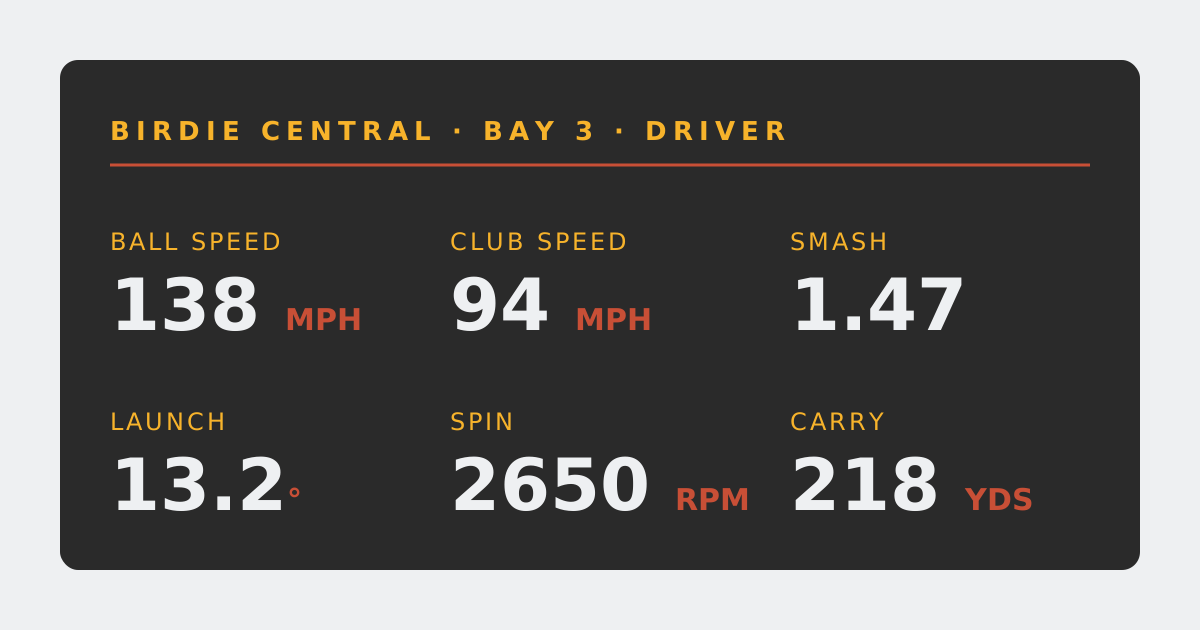
Start with these four numbers
Ball speed
Ball speed is how fast the ball leaves the face, and it's the single biggest ingredient in distance. Everything you do in the swing eventually funnels into this one number. For reference, PGA Tour players average driver ball speeds in the high 160s to 170s mph, while a typical mid handicap amateur lives somewhere in the 120s to 140s. Don't let the gap discourage you. Your job isn't to chase tour speed, it's to squeeze more ball speed out of the club speed you already have. Which brings us to the next two numbers.
Club head speed
This is how fast the club is moving just before impact. Trackman data puts the average male amateur around 94 mph with the driver, and a 20 handicap player right around 92. Club speed matters because it sets your ceiling, and each 1 mph you add is worth up to 3 yards. But here's the thing we see every week in our bays: most improving golfers don't have a speed problem. They have an efficiency problem, which is exactly what the next number measures.
Smash factor
Smash factor is ball speed divided by club speed, and it tells you how much of your swing actually made it into the ball. With a driver, 1.45 to 1.50 is the goal. Irons run lower by design, usually 1.25 to 1.38. If you swing 92 mph and your smash factor is 1.38, you're carrying it noticeably shorter than a golfer who swings the same speed at 1.48, and the difference is nothing but strike. Find the center of the face more often and you gain distance for free, no gym membership required. This is why smash factor might be the most valuable number on the screen for a mid handicapper.
Carry distance
Carry is how far the ball flies in the air before it lands, as opposed to total distance, which includes roll. Carry is the number that matters for course management, because water hazards and front bunkers do not care how far your ball rolls after it lands in them. Most amateurs guess their carry distances based on their best strike ever, then wonder why they're always coming up short. One honest gapping session on a launch monitor, ten balls per club, fixes this permanently. Many of our regulars say it's the fastest stroke saver they've found.
Local tip: Houston humidity is real, but indoor numbers are your baseline truth. The Uneekor XO2 reports carry in neutral conditions, so when you head out to Gleannloch or Willow Creek on a soggy morning, expect a few yards less than your bay numbers and plan accordingly.
Meet your numbers
An hour on a Uneekor XO2 will tell you more about your game than a summer of range buckets.
Book a BayThe flight shapers: launch angle and spin rate
Once the first four numbers feel familiar, launch angle and spin rate explain the shape of your ball flight, and together they're usually the answer to "why does my drive balloon into the sky and die?"
Launch angle is the angle the ball takes off relative to the ground. With a driver, most amateurs do their best work launching somewhere in the low to mid teens. Too low and the ball never gets a chance to fly. Too high, especially combined with heavy spin, and you're hitting a majestic shot that goes nowhere.
Spin rate is measured in rpm, and the ideal range depends entirely on the club. A driver generally wants somewhere around 2,000 to 3,000 rpm, enough spin to keep the ball airborne but not so much that it climbs and stalls. Irons are supposed to spin much more, roughly 5,000 to 8,000 rpm as you move through the set, because spin is what makes an iron shot hold a green. So don't panic when your 8 iron shows 7,000 rpm. That's the club doing its job.
If your driver shows 4,500 rpm of spin and a sky-high launch, you've just diagnosed a distance leak that no amount of swinging harder will fix. That's the kind of insight that turns a casual bay session into real practice, and if you want help translating the diagnosis into a fix, our AI swing trainer and the resident teaching pro are both happy to weigh in.
Why your ball curves: club path and face to path
The Uneekor XO2 also tracks club data, and two numbers explain nearly every slice, hook, and baby draw you've ever hit. Club path is the direction the club is traveling through impact, with a neutral window of roughly plus or minus 2 degrees. Face to path is the difference between where the face points and where the path is going, and it's what makes the ball curve.
The classic recipe for a slice is a path swinging left of the target with a face open to that path. See it once on the screen, in slow motion replay with actual numbers attached, and years of guesswork collapse into a single fixable picture. Golfers tell us this moment alone was worth the session. If you're brand new to simulator golf and want the full tour of how a bay works before you dive into club data, start with our first-timer's guide to indoor golf in Spring.
A simple three-session practice plan
Numbers are only useful if they change what you do. Here's a plan we recommend to improving golfers, one focus per hour-long session, no swing thoughts required beyond the number on the screen.
- Session one: gapping. Hit ten balls with every other club in the bag and write down your average carry, not your best. You now know your real distances, which is more than most of your weekend foursome can say.
- Session two: strike. Driver and 7 iron only. Ignore distance entirely and chase smash factor. Try tees at different heights, grip down an inch, slow to 80 percent. Watch what moves the number toward 1.48 on the driver.
- Session three: shape. Watch club path and face to path. Pick a start line and try to hit five shots in a row that curve the same direction. Repeatable curve beats occasional straight, every single time.
Run those three sessions in a couple of weeks and you'll walk onto your next tee box at Windrose or Gleannloch knowing exactly what your ball does and why. With 24/7 access through the Whoosh app, the 5 AM crowd and the midnight crowd both manage to fit these in around Spring traffic and day jobs.
Numbers you can safely ignore for now
Dynamic loft, lie angle at impact, angle of descent, apex height. All real, all useful, all better left for later. Club fitters live in these numbers, and if you get deep into the improvement journey they'll become interesting. But for a golfer working from the high 90s toward the mid 80s, the first seven numbers in this guide cover well over 90 percent of the value. Depth of data is a feature, not an obligation.
Frequently asked questions
What is a good smash factor?
With a driver, aim for 1.45 to 1.50. Irons run lower by design, usually 1.25 to 1.38. A driver smash factor well below 1.40 means strike quality is costing you distance you already have.
What launch monitor does Birdie Central use?
Every bay runs a Uneekor XO2, a ceiling mounted camera system that captures the club and ball at over 3,000 frames per second, with impact replays that show exactly where the ball met the face.
Which numbers should a beginner look at first?
Just two: carry distance and ball speed. Learn how far each club actually carries and let the rest wait. If that's you, our what-to-expect guide is the friendlier starting point.
Are launch monitor numbers accurate?
Camera based systems like the XO2 measure the ball and club directly at impact rather than estimating, which is why club fitters and teaching pros build their work around this data.
Bring your questions, leave with answers
Every golfer who gets serious about improving eventually has the same realization: you can't fix what you can't measure. The launch monitor takes care of the measuring. All you have to do is show up curious, and maybe bring a notepad for your new carry distances. A cold beer or a glass of wine while you review the data is optional but popular. If you're weighing a regular practice habit, our bay pricing and membership options make the math easy for Spring, Klein, and Gleannloch golfers.
Building community through golf
Book a bay, meet your numbers, and start practicing with purpose.
Book Your Bay